Showing posts with label family dialog. Show all posts

November 28, 2014

Between Parent and Child - How to start and keep this conversation

Where to begin to have a “real” conversation with their child? How do you conduct a conversation without falling into common pitfalls that results with a failure to communicate? This Roojoom will get you started.


April 15, 2012

Homemade Kanban - How to make it last?

Agile@Home :


After understanding Agile and Scrum, the first question that parents ask is, "will it last?"
Have you ever asked yourself that?
I asked myself the exact same thing when I first started this. Then I started to think about, why did it last, and what were those things that didn’t last. What did we gain out of this?
But first things first. As a parent how do we make things last with kids?

I say, if you want it to last, make it last, just know when to let go. It's not really different from any other educational or behavioral skill I want my child to gain.
Let's say, you want your child to go to school every day. You will make sure it happens. You believe it is important, or you appreciate the value, or it’s the law.
So now we apply this to the task board. You’ve already found this method interesting, and you know the value, and you are already thinking about implementing it.
Then it will last longer.

So first - Believe in the expected outcome. Children can feel when you believe in something (and when you don’t). Make sure both parents agree about it, as it will last longer.
I personally believe that like everything that’s 'fun' or more like a "game" lasts more with kids than something that’s perceived as ‘boring’. Kanban at home can be lots of fun for kids, as it has colors, boards, notes, ideas, dialog, empowerment ……… and a lot of attention!
Speaking of attention. Remember, we emphasize the family dialog above every thing else. The great value besides 'getting things done' is a family dialog. This dialog should last above all.

What happens is that once the task board and tasks are routine, many recurring annoying tasks are not an issue any more, as we manage and control them as part of the family routine. Once out of our way, we have time to deal with the really important stuff.
The task board is then filled up with more important stuff that the kids and the family want to share and accomplish. Issues at school, fun days, exams, family projects and more.


So sometimes you may find that you aren’t using a task board any more, but you ARE having a healthy daily dialog between the kids and the parents. And things are getting done around the house and for your kids. They achieve these values using wonderful Kanban tools - visibility, the ceremonies (daily, retrospective, planning), and so on.
Whenever we think that we need the Kanban board again, we just start using it again. There are many things we can apply the same method to. Cooking together; birthday party preparation; learning to an exam; cleaning the house tougher or planning a trip; TV schedule; whatever.

So I think it lasts as long as we see the value. And it's perfectly OK to stop and say that we don’t need it anymore, and if we have a specific need, start up a board again.
Applying Agile tools is, for example, having a daily meeting, visualizing your tasks, getting things done, looking ahead and planning, looking backward to see if you can do it better next time and learn. Communication is key.
The task board is just the means to make sure those things last.

After all, succeeding with Agile has a lot to do with mindset.


February 19, 2012

What is it about Agile and Kanban that teaches us and our children how to succeed?


Everything we need to succeed is here: 

1. Agile creates visibility. Visibility in turn creates security and control.
When I see where I’m supposed to go, I feel safe. Imagine you’re driving in the rain, at night. Now imagine you’re driving on a clear sunny day. Which one makes you feel safer?


2. Agile Kids enables you to clearly set challenges.
Our children put up everything on the board. They see what they are up against. It isn’t a vague in their heads. It is there, and belongs to them. They can see what is more and less important, it gives them a sense of control, reduces the confusion and leads them to success. They can also see their progress.
I will really ask my children, what do they intend to do tomorrow, next week or next month. And if you are planning a month in advance, what are you going to do? These tasks will go on the board, and we’ll see progress.

Prioritize your tasks:

This doesn’t mean that we’ll need a board every time we want to challenge ourselves - not at all. In the future, we won’t need the board at all.

3. Challenges according to age and ability
Each child chooses their own tasks, and moves forwards at their own pace. The board belongs to the family, and we each have our own tasks. Danny has tasks that are suitable for a first grader, and 12 year old Lisa already has tasks such as babysitting her brother when Mom is late from work. This way, the success is relative and suitable for each age. On the other hand, we can also see where we can move forwards. We see others’ successes and failures, and the children talk to the parents during the daily or weekly meetings, and they learn from their experiences.


4. The key word here is trust
I am training myself and my children to see what lies ahead. We are training to divide our tasks into doable actions. I am showing them the way. How a task is created, what happens during the progression, and how it ends. The training will make the board obsolete, but the principle remains the same. I experience successes (because I completed tasks), I saw the way, and I learned how to accomplish this.


5. Success is key
I’ll say it again. Children aren’t born with the ability to manage projects. They have to learn how to. They don’t always know how to divide their assignments into tasks, and some learn slower and some learn faster. What’s important is the feeling of success. They don’t need large rewards to feel they were successful - all they need is a smile and to succeed at their homework. That’s enough for them.

6. Listening
Listening to the children and listening to ourselves. It’s vital to succeed. Listening to what they have to say about their tasks during the daily meetings, giving them a place to be heard and to express themselves. When I speak, I’m learning and developing. When people listen to me and react to what I say, that strengthens the learning a thousand fold.


7. Empowerment
Setting these small goals, even from a young age, and enabling the child to choose their own tasks, is the basis for empowerment (weve written more about it here). And empowerment is one of the best ways to succeed.

8. The daily family pulse
The daily meetings and the order they bring to the house, send out a message. A message of doing, of support from others when I get stuck. I personally believe, that without these values, luck will be a major factor in our future successes, not our own actions or initiatives.

9. Initiative as a state of mind
Initiative is part of empowerment. The children are encouraged to take the initiative. Think of tasks, ask for help from others, and make things move when they get stuck. This isn’t just encouraged - it becomes a state of mind.

10. The state of mind and messages that come from the family and the house affect your children outside as well
For example, a singer’s son can become a singer with less effort than others. It’s not just the voice - you have to think like an artist as well, to know how to express your feelings, create, and so on, which is something that the child is immersed in at home every day. The same goes for doctors, or business people.
Now, just imagine that you immerse your children in empowerment. Every day, things that come naturally to them, will affect them in the future. Everyone agrees that it doesn’t matter HOW you raise your kids, it affects them a whole lot more than any courses they might take in the future. So isn’t it in our best interests to make sure they get confidence, empowerment, and the ability to follow tasks through?

Want to know how? Read the AgileKids book, and of course, get the latest updates from this blog.

January 29, 2012

Permanent task boards are nice, but they aren’t the point!

What do we do with all the permanent tasks? The ones that repeat themselves again and again? Those that we’ll be moving across the board every day?
One of the ways of creating Agile boards in the house is to reverse the columns.
What do I mean?

Well, instead of moving tasks through the columns, as we’ve shown in the book and previous posts, we put up a board with pre-defined tasks per family member, which are seen throughout the week, and add a ‘Doing’ note to the task in question.
I can see these boards posted everywhere. They are colorful, delightful, and some even have every possible task you can imagine that you would ever do around the house.
And that’s EXACTLY what bothers me.

People, don’t forget. The task board isn’t the point. The point is the way we treat tasks!
The point is communication, around the tasks at hand, with an emphasis on empowering the child, developing his responsibility and his commitment to the tasks, together with a healthy family dialogue, like I show in the Agile Kids book and in previous posts.
The family dialogue pulse is what matters. The task board is just an answer to a symptom, which can be disorganization, or not doing the chores around the house. The task board isn’t the goal.
We have to understand that setting up a board is just a means to more important goals.


And so:

1. Talk to your kids and build the list of permanent tasks together. This simple activity creates the initial understanding of tasks, and enables us to hear what our children think about the tasks, and you’ll be surprised at what they have to say. You might find that just from these conversations you can already agree on ground rules that will prevent arguments in the future.
Don’t force them. Don’t come with a pre-defined board and present it to them as a given. There can be some tasks that may cross some undetermined line (such as when to go to bed), but in an open discussion you’ll be able to present them as part of all the tasks.

2. Be prepared. Think in advance what you want to achieve. You can’t just pile a whole lot of tasks on the board, which makes it difficult to see who is doing what and when.

3. Focus is important. Choose the really important tasks first. With time, you’ll be adding more tasks anyway.

4. The children can create their own schedule from tasks that they are each interested in doing during the week. We’ll keep track of the schedule, and mark each task as done.

5. Put the tasks on the board together with your children. Visibility gives a sense of control, and is the first step towards taking responsibility for our tasks. This means that the children have to be part of creating the task list.

6. Put the board in an easily accessible part of the house, where everyone can see it. A task board that’s put in a drawer is useless. You can’t see it, and it doesn’t create any awareness of tasks and responsibility.

7. Meet once a day, and talk about the tasks. 

8. Make sure that the children are the ones that move the tasks on the board, not you. Let them choose and mark the tasks - not you.

9. Make sure that the tasks are more or less balanced, and that the brunt of the tasks fall on one family member.

10. You need to put your tasks on the board as well. This creates trust.
After we mapped out this week’s tasks, each task can be marked with a check-mark, a smiley, or any other mark that you choose. :)


And don't forget to have fun...

January 16, 2012

In agile, we teach our kids to Pull instead of get pushed


The ‘Pull’ system is a key principle in the Lean and Kanban world.
We’ll talk about it a bit more later, for those of you who are interested in Kanban and the Toyota assembly lines, but, in the simplest possible way, ‘Pull’ is when we actively choose and pull tasks instead of receiving them passively as instructions.

Just like everything else, ‘Pull’ in Agile at home is far simpler. And I’ll insist on keeping it that way, without over complicating matters.
So, if we follow this principle, I expect my child to be active, take tasks that belong to him, and not wait until I give him his tasks, or tell him what to do. That’s all. I want him to pull tasks, rather than wait for them to be pushed to him.
Excellent! We’re all happy!!
But hang on a second. How exactly do I do that?
I mean, it’s all simple and easy to write down (look above, I just did that), but many parents prefer to either do the tasks themselves, or worse, tell the kids what to do as they see fit. The children aren’t participants, just observers. I mean, I would rebel against that.
Being active is part of being empowered. When I control what I do, I develop my confidence, a sense of being able to do things.
For example, if you tie your six-year old son’s shoelaces, how would he learn to do it by himself?
You have to encourage him to do it by himself. Of course you need to be there for him, guide him and give him the tools he might need. I would also expect him to tie his shoes as part of putting them on, not wait for me to tell him.
Obviously, this doesn’t work for everything. I won’t do away with rules and limits completely. But within those limits, I will allow freedom of choice.
When we set up a task board with plainly visible tasks, we are already half way towards setting expectations with our children. What are the limits, what are the tasks that need to be done, and what tasks the child can add by himself. (I’m not talking about when you first introduce the board, when it’s recommended that you only put tasks that are easily completed, of course, but after a week or so.)

The board will also include tasks that you, the parent believe should be completed. Brushing teeth, tidying up the room and so on.  The ‘Pull’ will show when your child goes up to the board by himself, takes a task from the ‘To do’ column, and moves it to the ‘In progress’ column. You’d be surprised at how quickly they start choosing tasks that we think are important (brushing teeth, reading a book), and it is completely different from when a parent goes to the board and chooses a task for the child.
It’s exactly like when I’m at work, when I complete a task, I go to ‘pull’ the next task myself from the board. No one tells me what to do. True, the tasks are limited in number, and I know my work boundaries, but I choose my own tasks. My manager is pleased, and I’m in a constant state of work.
Take the opposite situation - I complete a task and go to my manager, who then assigns me a new task. My manager owns all tasks, and he is the one who assigns them to the employees.
In this case, I’m not really committed to the task - as it isn’t mine,  I start feeling that I get all the crappy tasks, and of course, when the manager is away, there’s no one to assign the tasks. I’m not in control over what I do, and I’m completely dependant on another to guide me.
You may think this is an extreme example, but you’d be surprised at how many companies work like this.


 OK, back to our home. Now do you understand why your kid comes home from school, drops his bag on the floor and goes to watch TV in the living room? Because he has a secretary called Mum, who owns all the tasks, and she will remind him what he needs to do. This is ‘Push’, and this is exactly what we want to change.
Agile and the task board are an excellent way to do exactly that.
The tasks are visible to all, the task pool is in clear site, and every one knows what their tasks are. All we have to do is create a mindset of ‘Pull’ rather than ‘Push’.
When someone is in charge of their own tasks, they’ll probably do them better. It starts by asking our child what his tasks are. Don’t be surprised when he says exactly what we want to hear (like tidying his room), and he’ll probably add more. It continues by having him write his tasks on a note, and adding them to the task board himself.
We might want to add a few tasks of our own at this stage, as it’s important that we set an example and have some tasks of ourselves on the board.
We’ll continue, and have the child pick his own tasks (I have to insist on this), the ones that he can complete over the next day, or the next week. These are the tasks that we’ll talk about in our daily meetings.
It’s important that he moves his tasks around on the board according to what he did that day - we want them to be active participants, right?
Every day we’ll look at the board again, and ask our children to tell us what’s going on with them and their tasks. You’ll see that very soon they’ll be adding more tasks, and problems will start coming to the surface.
A lot depends on us parents. When something is important enough, then it happens. For instance, if you need your kid to take his medicine, he does, right? So you CAN insist when you have to.


 To put it simply:
     ‘Pull’ is when we actively choose and pull tasks instead of receiving them passively as instructions. it means ,An active child is responsible for his own tasks.
     The task board is an excellent visibility solution . it is where we put things that we expect to get done.
     The child writes down his tasks, pulls them and moves them around - not the parents.
     The children participate in deciding what the next is going to be.
     A task is only pulled when the previous one is complete.
     We don’t flood the child with tasks, but allow him to set his own pace.
     We must provide the tools to complete tasks, and be there to guide our children.
     As parents, we must be the role model. Be there, place tasks on the board, challenge them to complete their tasks, add goals and encourage them.
     Determination.

Want to read more about Kanban and pull systems?
The need to maintain a high rate of improvements led Toyota to devise the kanban system. Kanban became an effective tool to support the running of the production system as a whole. In addition, it proved to be an excellent way for promoting improvements because reducing the number of kanban in circulation highlighted problem areas.
Pull / Kanban is a method of controlling the flow of production through the factory based on a customer’s demand. Pull Systems control the flow of resources in a production process by replacing only what has been consumed. They are customer order-driven production schedules based on actual demand and consumption rather than forecasting. Implementing Pull Systems can help you eliminate waste in handling, storing, and getting your product to the customer. Pull Systems are an excellent tool to use in the areas where cellular or flow manufacturing can not be achieved.


December 04, 2011

Agile and the International Academy of Education.


Can children benefit from Agile?  Yes, they can!

Not only can they benefit from it, but Agile also provides a good ground for learning. So implementing Agile at home with our kids has a valuable learning benefits as well.

I’ll give you an example. I found Stella VosniadousInternational Academy of Education' booklet the other day, and I was amazed at how the board of education study fits Agile principles. So having your kids practice Agile is not only easy and fun, but it is also helps your kids to learn. You can use Agile for studying for exams, getting ready for debates, home schooling and so on.

Just as an example, here’s an excerpt from the booklet:

"The psychological principles described in this booklet summarize some of the important results of recent research on learning that is relevant for education...    ...This research has offered us new insights into the learning process and the development of knowledge in many subject matter areas. ...schools today … are attempting to become more student-centred than teacher-centred”

So here are some major principles taken from this booklet that we actually employ at home using agile:

1.    Learning requires the active and constructive involvement of the learner.
"Learning at school requires students to pay attention, to observe, to memorize, to understand, to set goals and to assume responsibility for their own learning. These cognitive activities are not possible without the active involvement and engagement of the learner."

Encourage the active participation of your kid in the daily gathering. They are the ones actively assigning, moving and taking ownership over tasks.
No one can stay passive.


2.    Learning is primarily a social activity and participation in the social life of the school is central for learning to occur. Agile is primarily a social and team activity. We encourage the team to commit, to be accountable. Agile at home isn’t different. The children have a chance to practice their social skills in safety before they go out into the real word. Agile at home is based on the fact that the family is the micro of child socialization, so it acts as a safe zone where they can learn social activities and then to "try" them on in the real world is most effective. We gather as a family, we learn to talk, to present ourselves, we learn to retrospect and we learn to interact with dignity and empowerment.

3.    People learn best when they participate in activities that are perceived to be useful in real life and are culturally relevant.

Practicing Agile at home, going over relevant day to day tasks, like the Morning Routine, or the Evening Routine, makes a good base from which to build other learning activities. These are highly relevant to the child’s day to day life and can be a good infrastructure to other learning activities along the way, which is also one of the reasons that it works so well at home.

Of course, this is only the tip of the iceberg. I highly recommend you take the time to read the entire study, as there are more principles in these booklet statements about motivation, learning curve, which are all interesting to the Agile world.

So, how do our children benefit?
Children use Agile to learn, as it is a good learning and communication tool. They learn how to manage their chores better, achieve better results preparing for their chores and they learn how to plan ahead for complicated tasks, and they learn how to communicate with their parents and siblings.

When we bring Agile into our home, we don’t just bring in the boards, tasks, priority and commitment. We take in much more than that. We adopt the mindset. And the mindset proves to be aligned with what helps our children learn better.

So what did we take from Agile?
     We took the empowerment principles.
     We took the self management principle.
     The principles of working in a social environment.
     Sharing.
     Knowing how to present ourselves.

The children manage to communicate better, achieve teaching goals, home chores, learning better and, most of all, we have fun!

Enjoy!!!

Want to learn more?  The agile kids book.

November 14, 2011

Using the task board to initiate the family dialog.

Agile Kids: 

The Agile task board at home is not only about managing our daily tasks and chores as a family. It is also a good incentive for a family to start discussing those annoying tasks you never get around to doing, and more. The task board is just a tool, a tool that sets the discussion context.

After all, when we place our daily tasks on the board, we create visibility, when enables us to relate to each and every task. This creates balance. We don’t just relate to the problematic tasks that are stressing us out at that very instant, we relate to all of them. Before the task board, we only talked about tasks when we need to do them. For example, we need to brush our teeth NOW!, so that’s the only task we’ll talk and think about.


The task board also enables us to see the tasks in general, not just those that aren’t good, not that aren’t being carried out, which tend to get more attention than other tasks. Our attention to those tasks that aren't carried out can also single out a single member of the family as the trouble maker, as the noise and attention to his tasks are greater than any others. You know what it’s like when one parent comes home after a long day, and immediately loses his or her temper over tasks that weren’t completed that day, making a whole scene that overshadow any discussion and don’t improve the general family mood at all. The task board enables you to set aside a specific time to talk about the tasks, and helps put in proportion those tasks that weren’t completed, and what impact the results really have on the family.

The task board, as you know from work, enables us to see the successes, and give feedback where necessary.

As the family starts getting used to the idea to talking about the daily tasks at a specific time during the day, and dealing with them one by one, you’ll find you have time. Time to talk to your children about things you REALLY want to talk to them about, like values, social matters, and so on, and all this without singling these discussions out as problematic even before we started talking to them. They just become part of the natural flow, and we treat them like any other task. After all, as time goes by, and we talk about tasks, they resolve themselves, and stop being so urgent, which leaves us room to talk about other things.

Talking about the tasks has a magical effect on the kids, sometimes just due to the fact that we dedicated time to talk about what’s going on with them at home, listened and acted, especially when it comes in the shape of a large colourful board and a game, but most importantly, because we, the parents, set aside time just to talk to them. Even if it’s just 15 minutes, they are very efficient 15 minutes.
After working for a few weeks, task boards start to take on different shapes and sizes. Sometimes you can even tell the family’s unique mood and dialog presentation by looking at them.

They might vary from one family to another with the columns, number of tickets and issues detailed in them, but the important stuff stays the same. The communication over the daily tasks which facilitate a family dialog.

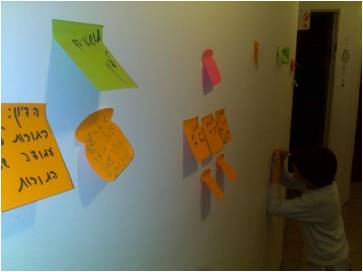
See for example, a family that really enjoy having a task board -
  • Note the "issues for discussion" notes, which is the first sign of a family managing to elevate the use of a simple task board into a real dialog between parents and kids.
  • As the task board is actually a wall, the kids use notes to indicate column titles.
  • Kids make the board more elaborate
  • They add new sticky notes in different shapes, with colorful Smilies showing who’s the task owner.
  • Some tasks you can really see that the child has dedicated effort to writing down its content, which shows his understanding of the task, and has a good learning value.


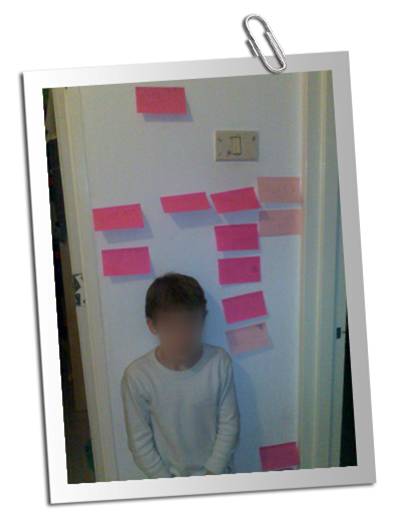
Personal agile board:
Although it singles out a specific family member and their needs, a child initiating his own task board is actually inviting us into a dialog.


Want to learn more? The Agile Kids book