International educator Scot Hoffman is a big believer in the power of curiosity to drive learning. After nearly two decades of teaching around the globe, he also realizes that school isn't always so hospitable to inquiring minds. (As Einstein said, "It's a miracle that curiosity survives formal education.") That's why Hoffman has developed The Curiosity Project, a self-directed learning experience that engages students, parents, and teachers as collaborators in inquiry. A six week long project design in away to make it interesting and exiting and not stressful to work with kids curiosity.
Showing posts with label education. Show all posts
March 13, 2014
Using the power of curiosity to drive learning.
January 25, 2014
Last Thing First - Back-chaining
Usually the process of teaching people how to successfully complete long sequences of is to teach how to start the task sequence and then proceed right along to the end of the chain of events. Backward chaining however refers to breaking down the steps of a task and teaching them in reverse order. The biggest advantage from the learner’s point of view is that it offers immediate satisfaction. It minimize anxiety and provide a sense of accomplishment. This feeling of success will increase confidence and keep us motivated to learn and complete the entire sequence of steps.
October 13, 2012
How to study for your next exam with Kanban
The best way to plan and execute a project is of course,
using Agile. But planning an Agile project, even around the house, is not just
about Kanban, it's also about adopting the right way of continuous planning.
The GTD (Getting Things Done) approach, and being able to follow through, make
conclusions and make changes, based on real life changes.
Let's take studying for exams as an excellent example.
I
still remember the pressure as a student, when you have to prep for several
exams together, each one covering a whole semester. I had tons of material to
cover – and of course, I was also waiting tables at the time.
It's not easy to study, work, schedule around the exam dates
and cover all the material, when you sometimes have to cope with seven exams in
a month. In fact, it requires a plan.
As luck would have it, we have this post about Agile to help us plan
this out J
1. Create your
backlog:
Use continuous planning methods –drill
down to the level of detail you need at the righ moment.
” Lets think of the planning
process as continuously decomposing a product vision while focusing on those
features of greater priority (value) to the business. This decomposition uses
just-in-time methods to prevent wasted effort on lower-priority or unneeded
features. That is, we expand on features just as much as we need to according
to our expectations of when we will build them (this order is determined by the
value they provide to the customer).
This plan enables the team to
look ahead responsibly so that large-effort activities can be broken down in
small enough segments (right-sized work) and balanced against higher priority
items that come up. A good release plan provides a clear visual control and
obviates the need to look too far ahead and work too far in advance on future,
larger features."
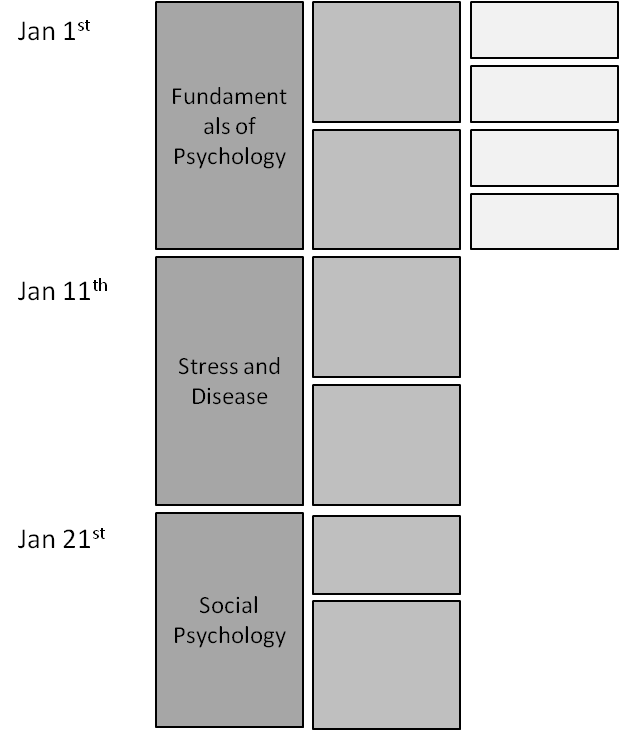
For starters, to cover the studying period, list the
courses that you'll be taking exams on. Don’t go into detail yet – look at
the first column in the chart below.
Visualize your courses with different colors.
Visualize your exams timeline.
Order your exams according to their set date.
Tip: Estimate the effort it will take you to study
for the exam using our simple sizing technique.
This action will allow you to visualize your ability to complete those building blocks.
Now that you have your overview, start drilling down into each subject, adding elaboration where needed. Do just what you need, no more.
(For example, if you were planning a wedding, you'd write down high level tasks (where, when, dress, guest list). You don't start writing down who sites where (or at least, not until you are much closer to the wedding day).)
·
Each course exam is broken
down into reasonable study units
·
Some units are broken down
further, if required.
·
You don’t have to go into
minute detail on all the units – just those you need to at the time. For
example, if “Fundamentals of Psychology“ is coming up, I'll break it down into
smaller parts, and when I really start studying, I will break it down to even
smaller tasks.
Priority level of details settings:
When you drill down into each exam, decide how detailed you
want it to be. Do you really need the details of every sub-subject?
Ready
To Go:
These
items are what you need to start working on right away, and so have the maximum
detail necessary. They have a clear definition of 'done' (For example: pages
1-20 + answer questions 23-56)
Don't
add too much detail!
Don't
add detail for every task, for every subject, for every exam, right away. When
the date approaches – then you can start fleshing things out with more detail.
Work
with small items, meaning make sure ready items are in a level of
details that is reasonable to achieve. ‘(a day size item may be enough).
Use
sticky notes as a good visualization of what we need to study. It also
makes sure that you can quickly change, add and adapt to change. (Agile,
remember?)
2. In progress: what we actual studying.
·
Pick up items according to
priority.
Learn one topic at a time and move it along the board.
Work on one item at a time.
Learn one topic at a time and move it along the board.
Work on one item at a time.
3. Done
Follow the Definition Of Done. It’s not done till it’s done.
© Example taken from myagile.co.il.
תוויות:
education,
kanban,
kanban boards
September 29, 2012
I Do, We Do, You Do - Agile@Home (Technique )
I came across a nice post , which explained the “I do, we do, you do “
technique beautifully.
‘But Shirly,’ I
hear you asking, ‘What IS the ‘I do, we do, you do’ technique?’.
The formal
explanation is here:
“Kids internalize concepts through gradual
release: a teacher models a concept or skill while kids observe (“I do”);
kids engage with the concept or skill with lots of teacher support (“we do”);
kids give it a shot on their own (“you do”). “ 3 Quick Wins for Kids Ministry
This is a
common teaching practice used with students, and is also frequently used when
you introduce Agile to teams. The way I see it, kids and families can also
benefit from this concept at home - especially when combined with Agile.
As always, I’ll
keep it simple. If you want to read more, there are links at the bottom of this
post.
In most of the cases the scrum daily meeting is
a new skill that the team needs to learn. This meeting is time boxed for 15
minutes regardless of the size of the team, and looks to review the team work
progress, the team’s commitment, and help the team focus, identify and
eliminate impediments to progress.
Sounds simple?
You need to learn HOW to do it. The team has to
learn how to conduct this meeting in the most effective and efficient manner.
So sometimes I use the “I do , we do , you
do” technique. The first time the team gathers for the scrum daily meeting,
I, as a coach, will take the role of the scrum master and facilitate this
meeting. I will make sure the team and the scrum masters observes (“I do”).
Next meeting, I will ask the scrum master to
facilitate the meeting with me, together, (“we do”) . I will stand next
to the scrum master and let him lead while I fine tune correct if and where
it’s needed. Usually the ‘we do’ part takes no more than one or two sessions
until the scrum master and the team feels they can do it themselves.
In the “we do” stage , its extremely
important to get the team feedback and get feedback from the ‘student’, to
understand if they are confident enough to manage by themselves.
The third step will be the “you do “. I
stand back and let the scrum master and the teams take the lead.
At each step, I will provide the team with
relevant feedback.
If I need to fine tune of a process, or introduce
a new method needed teaching, I may repeat this process.
So where’s the big problem?
Well, the problem starts when we use concepts
that we already know - as managers, as teachers, or as parents, and we expect
new participants to immediately understand what we are talking about and follow
it. In other words, we expect others to start from
the ‘you do’ phase, without going through the other two phases.
For example, Management discusses and learns a
new meeting process, and the developers get an email telling them what to do in
their next meeting. Do we actually expect them to learn a new practice from an email?
One that took the managers the better part of a day to discuss and understand?
Exactly the same thing happens at home with our
kids. You can’t expect them to ‘get’ something that took you a long time to
learn.
Going through these stages is necessary, and
important. It makes sure that even those children who think they are fast
learners follow each step, until they have really learned and understood.
Combine this technique with Agile, and it’s
awesome to use at home.
Among other things, Agile brings the concept of
visibility to the table, as we use the task board to reflect our progress. The
advantages of visibility are widely known to be a powerful for learning and as
a “get things done” tool.
Visualization as a family holds enormous value,
as I’ve written before. It shows the progress, pushes us to perform as a group,
enables us to get feedback, prevents singling out problematic team members, and
so much more!
Agile adds the communication value and the need
to plan and retrospect over our performance.
It also holds lots of mindset and empowerment aspects which enhance learning and the feeling of self
capability.
And it is so simple to implement, like it’s a
quick win
So when we speak about Agile and boards,
specifically about the visualization aspects, we can have several of
visualization and implementation options in this area.
We could just add the following columns to our
board:
I do , we do , you do.
Need to learn a new subject? Make it into a
sticky note, and move it across these columns, with each one representing the
learning phase of a task we are in.
To sum up - the following rules are applicable
in most cases:
1.
Visualize your tasks. Visualization makes it easy to put things in order, get
things done, acknowledge our progress get feedback and gain the feeling of
control. Use a task board. Make sure
every learning task is on the board.
2.
As
always, divide big issues into smaller ones and go ahead. Don’t use
massive learning tasks with massive step as one learning issue. Split it to
smaller ones. But keep the big
picture in front of you. After all, learning is not only about doing small
steps. The big picture is sometimes very important for the child to be aware
of.
3.
Pull one
task, complete it , and then pull the next task in line.
4.
I do – model the step yourself - eliminate “going ahead” just because we think
we know how to do something.
5.
We do - Do it together with your kid. It can be a one-on-one session, or a
class session where we all do it together. At the end – place the card on the
board.
6.
You do -Let them get things done – each child using his card to perform the
task .
8.
If the
child doesn’t succeed completing one of the stages, learn from it. It’s
perfectly OK to try again, to practice some more.
9.
Of course
, don’t forget the communication aspect. Talk things over, retrospect
over your performance and learn
10.
As
always, don’t forget to have fun.
References and reading:
http://www.scrumforteamsystem.co.uk/ProcessGuidance/scrum/process/daily-scrum-meetings/daily-scrum-meeting-rules
תוויות:
agile,
children education ; agile at home ; agile kids,
education,
family tasks,
i do we do you do,
task board,
task card,
tasks
Subscribe to:
Posts (Atom)