Encourage a videogame? With a screen? As Nick Bilton wrote in a New York Times article urging parents to calm down about Minecraft, a Stockholm school has made Minecraft a requirement for its 13-year-old students because it helped them learn to plan. With millions of users, this wildly popular game mostly involves a world in which you manipulate really really big Lego-like objects. The game requires that you build shelters and tools to fend off zombies and other predators who come out at night. This game have an enormous learning, motivation and creativity benefits. So let’s start playing.
Showing posts with label kids learnning. Show all posts
May 03, 2014
Minecraft Is Shaping A Generation, And That Is A Good Thing
תוויות:
fun game,
kids learnning,
Learning,
Minecraft,
video
March 18, 2012
Time management games, multitasking and Agile
OK, I confess, I can find the
Agile connection in nearly everything. It’s just that practising Agile at home
is not just a fantastic communication tool, it also teaches us how to manage
ourselves better, more goal oriented and effective.
In one of my earlier posts, I explained how we should manage our
task lists better, and see what needs to be done, using the Eisenhower Method.
The Eisenhower Method is a basic time management method.
Today, I’d like to suggest we play games. Yes, I said games.
Computer games, that do nothing but make your kids spend hours in front of a
screen.
Apparently, that’s not true. Really.
When I started to look more into games that seemed a
complete waste of time, I noticed that some of them have serious aspects of how
to be effective and manage your time in the best possible way.
I believe that experience is built from training, and
intuition is built on the ability to make choices, to ‘feel’ what’s right,
based on previous experience. And these games, that consist of a message and
constraints, such as ‘manage a pizzeria’, are exactly that. These games force
us to practice our efficiency and speed, to focus, and to achieve our goals.
The game trains the player to be goal-oriented, but also effective, teaching
you something that you can’t learn just from talking about it, and it’s no
secret that children learn the best by playing. So do adults, by the way.
"Refurbish
a rundown castle and turn it into a pizza palace! Armed with their secret
family recipe, Rebecca and Robert are out to build a successful pizzeria
franchise. Save money to spend on new appliances, better menu items or
developing their skills. Accumulate enough to open a second location in an even
more unique setting. Restaurant management has never been so fun!
·
- Multi tasking demanding high efficiency to serve
a lot of customers with the right order and the right time.
- Grow your business - Buy new items and upgrade
your restaurant
- Set up higher
goals every round
- Explore 50 challenging levels"
More games:
תוויות:
agile kids,
education,
kanban family,
kids learnning,
time management,
to do list
February 05, 2012
Balancing the task list & Creating a task board for 10 and 12 years old kids
1. Presenting the idea:
What’s the biggest problem with kids? That they
always forgot to do their chores, and we parents find that we have to act as
their memory, and constantly remind them to perform their tasks.
When we keep on reminding the kids of what they
need to do, we also become the task
owner. Want proof? Well, If we aren’t around, are the tasks completed?
It’s not easy, by the way, to come home from
work every day and immediately start talking about what hasn’t been done today.
‘Why is your bag in the middle of the room?’, ‘Why haven’t you had a bath
yet?’, and so on.
And along comes Agile for Kids.
When we introduced Agile for Kids, this family children didn’t want to
go along with the sticky notes, but they immediately understood the problems we
were talking about. So we went along with them. After all they are the ones
that are going to own the tasks and perform them later on this week.
2. Cleaning the old white board – just for fun
3. Balancing the task list:
After the board was cleaned, we asked the kids to write down all their
weekly tasks.
Each kid read out one task, and the other balanced his list accordingly.
Of course there were tasks they missed, tasks they didn’t agree on, or tasks
that their father wanted to add (such as, ‘Don’t forget to take your house key
with you’). This is a real discussion, and it is the heart of the Agile Kids
method.
Finally, they agreed on one task list. This will be our backlog.
The real purpose of this exercise is, of course, to have them write down
and own their tasks, and remember what they have to do.
4. Gathering ideas to build the board:
As they didn’t want to use sticky notes, we made sure they plan the
board as they saw fit. Of course we insisted that they do it together.
Always keep in mind that our real goal is discussion, and to make sure
they know what they are supposed to do. It is their board, which means that
they are accountable to create it as they see fit. Yes, as parents we can recommend
some changes, and we will review the board during the daily meetings and
encourage them to improve it.
But we must remember: The board belongs to our kids.
5. Building the board:
Remember, the kids do this, this is their board, their responsibility
and they are the ones who are accountable for completing the tasks. This is
exactly why they are the ones who need to build it as they see fit.
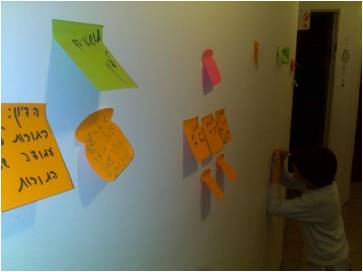
Above you can see the discussion over placing the tasks on the board and
the best place to place the task board.
תוויות:
agile family,
agile kids,
homeschool,
kanban boards,
kanban time frame,
kids learnning,
kids scrum,
Kidsban,
schedule board
December 26, 2011
Wishes you Merry Christmas
תוויות:
agile kids,
kids learnning,
kids scrum,
Kidsban,
Marry Christmas,
Santa
December 18, 2011
Empowering kids with Agile is actually pretty simple.
So what exactly is ‘empowerment’?
In one sentence, we can define
empowerment as a process where the one with power (that’ll be you, the parent)
gives up some of his power for another (your children), and at the same time he
also maintains his limits and authority. This way BOTH sides grow and gain in
strength.
In fact, we change from a
position of no control, to a position of relative control. The empowerment
process strengthens the self-confidence of the one being empowered, in his
ability to function, make decisions and complete tasks.
In the work environment, the
manager is the one with the power, whereas the employee is the powerless one.
Take for example, an employee who is constantly getting chewed out. At some
point, he will stop taking initiative and will only wait for instructions. Why?
To avoid being punished for his mistakes. And neither he, nor the organisation,
will grow.
Sometimes, it’s enough to
strengthen the feeling of success to create the seeds of empowerment. In fact,
from all the components of empowerment, the feeling of success is in my opinion
the most important.
As our perception of reality
alters our mood, sometimes all that is needed is to show how to perceive
reality differently, which can change our mood.
For example, when a kid learns to ride a bike, he will feel
successful when we encourage him even when he falls. We tell him that everyone
falls when they just start out riding their bike. We tell him to look forwards,
not down - and be there when he falls. When he finally learns to ride his
bicycle, he will feel that he can do anything. On the other hand, if the kid
learns to ride his bicycle after we tell him the whole way ‘why are you
falling?’, ‘why aren’t you holding on?’, ‘how many times have I told you to
look forwards?’, his feelings of success will be dwarfed by his disappointment,
and we will miss out on the feeling of empowerment we could have achieved. Our
child’s experience was one of failure.
Empowerment includes several
elements, which are all included in Agile in the house.
“...empowerment encourages people to gain the skills and
knowledge that will allow them to overcome obstacles in life or work environment
and ultimately, help them develop within themselves or in the society."
In fact, if we take a look at empowerment, we can see
that through the Agile mindset and actions, we give our children exactly that -
and more. For example:
The ability to make decisions
about personal/collective circumstances:
We create our task board at home. The board includes
the tasks, decisions, and what we need to do. We stand in front of the board
every day, and our children place their tasks on the board, deciding what they
need to do today (or tomorrow). This ability, to place his own tasks and make
his own decisions, is very important, and contributes a lot to his sense of
ability and worth. It’s true that we, as parents, will place the limits, and
ensure that tasks such as ‘only eat candy’ won’t be on the board, but within
those limits - the child makes all the choices.
The ability to access
information and resources for decision-making:
The task board enables
visibility. We are around it every day. Visibility enables control. No more,
and no less, and without noticing, that control strengthens our feeling of
being capable. It doesn’t really matter about what in the beginning. When we
feel in control, even of something small, with time we can leverage that
feeling to our weaker areas as well. The family retrospective session enables
forwards visibility, which gives children, and us parents, a sense of security.
The situation becomes less vague and enables the children to function and make
decisions with more certainty. When I know that Daddy will be coming home late
all next week, I can plan tasks just for us, or with Mummy, or understand why
Daddy isn’t reading me a bedtime story.
Ability to consider a range of
options from which to choose, not just yes or no:
It’s very important to use the
board to create options to choose from, and discuss those options.
Agile provides just the platform
you need for this. There are many tasks on the board, and I can choose what to
do. I am with my parents, and I discuss my choices with them. We recommend that
you offer more than one option. Standing in front of the board and telling your
children what they are going to do next misses the whole point of Agile Kids!
You need to ask and guide your children. The task board is an excellent tool
for this, as it focuses the conversation, and places all open issues in front
of everybody, without singling out a specific family member or task as
problematic.
Ability to exercise
assertiveness in collective decision making
The whole family takes part in
the daily meetings. Even if they are short, they still enable us to experience
the decision-taking process together. The discussion itself enables growth. The
children learn very fast to introduce themselves, talk about what they did the
day before, what they did today, and what they intend to do. They learn to
focus on what’s important, and make decisions accordingly.
Having positive-thinking about
the ability to make change
When I succeed, I’ll think of
success. When I see my success, I will see change. When I see change, I’ll
start believing in it, as well.
Ability to learn and access
skills for improving personal/collective circumstance:
The family is a micro social
environment of the outside world, through which we learn behavioural patterns. Agile
Kids gives us time to talk, learn from each other, look ahead, plan and learn
from mistakes. This way, instead of dealing with things that aren’t getting
done, we focs on what’s really important, and have time to learn new skills.
Involving in the growth
process and changes that is never ending and self-initiated:
The children see their progress
and success daily. They don’t just talk about it, or are told that they have
succeeded - they have tasks in front of their eyes that have moved from one side
of the board (‘To do’) to the other (‘Done’). And they were the ones doing the
moving. It’s amazing how much this visible evidence of success delights them.
The more colourful and full the
board is, the more they feel successful. Add to this the fact that we, the
parents, are also there, seeing the success and talking about it, showing our
children how proud we are.
The task board creates a feeling
of involvement. We are the ones building the board, and we are the ones using
the tool to bring about change. Sometimes this is exactly why we recommend that
you start by putting tasks on the board that are likely to be completed
successfully. If your child is having a hard time at maths, don’t start with
that task. Start with something simple, like brushing their teeth every night.
Build on that success, so that you can deal with the harder tasks later on.
Dealing with tasks isn’t magic
(like suddenly developing an aptitude for maths) - it’s just being open to new
methods of dealing with difficult tasks (such as breaking tasks into small
parts). The willingness to open up to new methods is built on the feeling of
success felt on achieving other tasks.
Increasing one's positive
self-image and overcoming stigma
We’ve talked about this before,
so in just a few words - sometimes it’s much easier for us to tell our kids
what to do, rather than let them decide for themselves. When to tidy their
room, what’s wrong - instead of telling
them how fantastic they are. Instead of feeling success, they just feel
failure.
When you come home, and just
complain about the tasks they didn’t do, you don’t compliment them on the tasks
they DID do.
Agile Kids enables you to develop this pattern, and creates
order and visibility around all the tasks. This opens a place for the family to
talk about the tasks - and leaves plenty of room for praise.
So smile. Say how happy you are.
And have fun!
References
●
Blanchard, Kenneth H., John P.
Carlos, and Alan Randolph. Empowerment Takes More than a Minute. San Francisco:
Berrett-Koehler, 1996. Print.
●
Stewart, Aileen Mitchell.
Empowering People (Institute of Management). Pitman. London: Financial Times
Management, 1994. Print.
●
Thomas, K. W. and Velthouse, B. A.
(1990) Cognitive Elements of Empowerment: An 'Interpretive' Model of Intrinsic
Task Motivation. Academy of Management Review, Vol 15, No. 4, 666-681.
●
Wilkinson, A. 1998. Empowerment: theory and practice. Personnel Review. [online]. Vol. 27, No. 1, 40-56.
Accessed February 16, 2004.
See also
תוויות:
agile family,
agile kids,
education,
empowerment,
kanban family,
kids learnning
December 11, 2011
What is a schedule board?
My friend’s kids, who have been practicing Agile at home for quite some
time, started up their own board after fighting endlessly over who gets the
television remote, and who’s turn is it on the computer.
The kids basically created two boards in one. One board for the computer
and one for the television, putting up a sticky note to mark what each one did,
and when. This way, they knew exactly who played what, and who’s turn it is
next to watch their favorite TV show or playing on the computer. They even
added a column for discussion.
This is the really amazing part that kids learn from Agile. When they
have an argument, they just turn to a board for a solution, and make sure they
have a place to talk over things during the daily gathering.
We really liked the fact that they thought about
it for themselves and had the tools to initiate a solution. It might not be the
most effective board, but it did the job, and solved the problem (at least for
now :)) and this is what counts!
When my friend came home, the board was already set up in the living
room, and her kids showed it off to her proudly, as kids do. The family made
sure to track the board over the next few daily sessions, and very soon it
became routine.
תוויות:
agile kids,
kids learnning,
kids scrum,
schedule board
December 04, 2011
Agile and the International Academy of Education.
Can children benefit from Agile? Yes, they can!
Not only can they benefit from it, but Agile
also provides a good ground for learning. So implementing Agile at home with
our kids has a valuable learning benefits as well.
I’ll give you an example. I found Stella Vosniadou’s ‘International Academy of Education' booklet the other day, and I was amazed at how
the board of education study fits Agile principles. So having your kids
practice Agile is not only easy and fun, but it is also helps your kids to
learn. You can use Agile for studying for exams, getting ready for debates,
home schooling and so on.
Just as an example, here’s an excerpt from the
booklet:
"The psychological principles
described in this booklet summarize some of the important results of recent
research on learning that is relevant for education... ...This research has offered us new
insights into the learning process and the development of knowledge in many
subject matter areas. ...schools today … are attempting to become more
student-centred than teacher-centred”
So here are some major principles taken from
this booklet that we actually employ at home using agile:
1.
Learning requires the
active and constructive involvement of the learner.
"Learning
at school requires students to pay attention, to observe, to memorize, to
understand, to set goals and to assume responsibility for their own learning.
These cognitive activities are not possible without the active involvement and
engagement of the learner."
Encourage
the active participation of your kid in the daily gathering. They are the ones
actively assigning, moving and taking ownership over tasks.
No one can stay passive.
2.
Learning is primarily a
social activity and participation in the social life of the
school is central for learning to occur. Agile is primarily a social and team
activity. We encourage the team to commit, to be accountable. Agile at home
isn’t different. The children have a chance to practice their social skills in
safety before they go out into the real word. Agile at home is based on the
fact that the family is the micro of child socialization, so it acts as a safe
zone where they can learn social activities and then to "try" them on
in the real world is most effective. We gather as a family, we learn to talk,
to present ourselves, we learn to retrospect and we learn to interact with
dignity and empowerment.
3.
People learn best when they
participate in activities that are perceived to be useful in real life and are
culturally relevant.
Practicing Agile at home, going over relevant
day to day tasks, like the Morning Routine, or the Evening Routine, makes a
good base from which to build other learning activities. These are highly
relevant to the child’s day to day life and can be a good infrastructure to
other learning activities along the way, which is also one of the reasons that
it works so well at home.
Of course, this is only the tip of the iceberg.
I highly recommend you take the time to read the entire study, as there are more principles in these booklet
statements about motivation, learning curve, which are all interesting to the
Agile world.
So, how do our children benefit?
Children use Agile to learn, as it is a good
learning and communication tool. They learn how to manage their chores better,
achieve better results preparing for their chores and they learn how to plan
ahead for complicated tasks, and they learn how to communicate with their
parents and siblings.
When we bring Agile into our home, we don’t just
bring in the boards, tasks, priority and commitment. We take in much more than
that. We adopt the mindset. And the mindset proves to be aligned with what
helps our children learn better.
So what did we take from Agile?
●
We took the empowerment
principles.
●
We took the self management
principle.
●
The principles of working
in a social environment.
●
Sharing.
●
Knowing how to present
ourselves.
The children manage to communicate better, achieve teaching goals, home
chores, learning better and, most of all, we have fun!
Enjoy!!!
תוויות:
education,
family dialog,
kids learnning
Subscribe to:
Posts (Atom)