November 28, 2011

Are we overloading our kids with tasks? And if so, what can we do about it?


The answer is simple. Focus!

If you want to get your kids to perform their chores, one of the most important factors is focus. This is one of the keys to your success. The task board is an excellent solution for scope and focus our attention over the most important tasks and getting them done.

Sometimes we get to the point where our kids feel like they have too much to do. This might even be because of us, the parents. Not because we give them a lot to do, but because sometimes even a few simple (to us) tasks seem huge to our kids. Sometimes we forget that they aren’t really small adults at all, but children. Children who aren’t very experienced at setting goals or priorities.

I find that parents come home and immediately start with a list - “take out the garbage, pick your coat up from the floor, why is your plate here, and why is your room in such a mess?”...

Even I can get stressed out from a list like that, and kids take it even worse.

Homework is also a task that can cause stress - what seems simple to us, like four pages in English and two in Maths can create a feeling of pressure to get the tasks done. Ask him to empty the dishwasher as well, and you’ll find that it’s too much for them to handle.

If we succeed in changing the way they perceive their tasks, then we will be able to change the feelings that follow hearing about these tasks as well. So for example, there are tasks that we can head off the pressure before they start - for example, what do I do when I come back from school? Put the coat and bag in the room, eat lunch, clear the table and tidy up the big stuff in my room. Other tasks we will split up into smaller tasks - for example “Maths” would be the header, with “Page 1”, “Page 2”, etc. will be the tasks.

So how does the task board help us here? It’s simple!

One of the Agile principles of managing the work flow is first to be able to visualize it.

So our first step will be to do exactly that.
Draw three columns ( to being with) on a white board. Our flow will be to have tasks that we need to do, those in progress, and those we have done.

Put the tasks on the board, and you can visualize where you are today.

See? Simple!

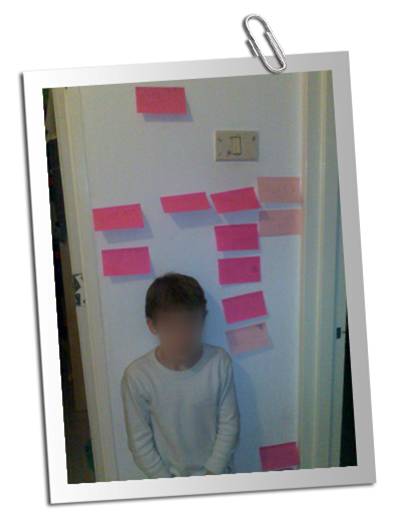
In the following example. Adam has tons of tasks to complete, AND he’s expected to do his homework. No wonder he is stressed. This stress will probably cause him to drop everything, and try to avoid doing any of his tasks at all.


One of the main advantages of the task board is, that it makes our chore bottlenecks visible.

Now we can place the tasks in the right order, and we can see if we are overwhelming anybody with their task load.

The second, and not less important principle is to limit our Work In Progress, or WIP.

This means that you can only have so many tasks that are in the ‘Doing /In-progress’ column at the same time.

Sometimes limiting the tasks that are overloading our WIPs is the best way to get things done. Starting from doing one thing at a time (Yes, we can set more sophisticated WIP flows, but you are dealing with kids and basic principles, so keep it as simple as possible).

Limiting our WIP load doesn’t mean you should stop doing things. It just means that you need to control what you are doing at the same time, in parallel, and limit it to what we are really able to handle. As all tasks are now visible on the board, we will make sure to do one thing at a time. Adding more and more chores to the ‘Doing’ column won’t help if you child is already bogged down with tasks, and starting more and more new tasks without finishing old ones only leads to delays and frustrations.

Keep in mind that we are at home with our kids - not at work with our team or employees. This means that our ability to control the load is much more simple:

1.    Decide what important.
2.    Decide what comes first (priority).
3.    Divide tasks up into small chunks if possible.
4.    How long will it take?
5.    Work on one task at a time.
6.    Pull tasks from the “To-Do“ column only when your completed the previous one.

So if you told your child to do lots of things at once, now you have a different method. Visualize everything you want them to do, give each task the right importance and priority, pull tasks only when you are done doing the last task, and you’ll feel how the sense of being under pressure is lifted.

Take the first example we gave, what the kid needs to do when he comes home from school. There are a few solutions for the problem, such as:
1.    Planning in advance the ongoing and repeating tasks, and placing them on the board.
2.    Limiting, prioritizing and timing those tasks to the right time and place.

This way, instead of dropping all the tasks on the kids at the same time, when the kids get home they can see the task board and know what they need to get done. The child then selects one task after another, moving them into the ‘Done’ column when they are complete.


Let’s take the example of homework:
Let's teach the child to divide into smaller tasks. Then visualize those tasks on the board, and decide together on right time to perform those tasks.


So, to focus means:
1.    Visualize your flow
○     Identify our list of tasks /chores.
○     Identify the crowded areas or bottlenecks.
2.    Limit our load, or actions to reduce the load:
○     Plan tasks and chores that we know need to be done at a specific time in advance.
○     Decide priority, timing and importance...
○     Divide to small chunks.
○     Stop working on other tasks, and focus on moving bottleneck tasks forward.
○     Do one thing at a time at our own pace.
○     Pull  - Only start a new task when we complete the previous one

Sometimes we can put a WIP limit over our 'In Progress/ tasks, but this is something for another blog :)


Want to learn more about Kanban?


November 22, 2011

The best way to deal with kids and their chores


Chapter 14 in the Agile Kids book shows how to use the task board in real, every day, situations. Here's a short video showing the highlights.

November 14, 2011

Using the task board to initiate the family dialog.

Agile Kids: 

The Agile task board at home is not only about managing our daily tasks and chores as a family. It is also a good incentive for a family to start discussing those annoying tasks you never get around to doing, and more. The task board is just a tool, a tool that sets the discussion context.

After all, when we place our daily tasks on the board, we create visibility, when enables us to relate to each and every task. This creates balance. We don’t just relate to the problematic tasks that are stressing us out at that very instant, we relate to all of them. Before the task board, we only talked about tasks when we need to do them. For example, we need to brush our teeth NOW!, so that’s the only task we’ll talk and think about.


The task board also enables us to see the tasks in general, not just those that aren’t good, not that aren’t being carried out, which tend to get more attention than other tasks. Our attention to those tasks that aren't carried out can also single out a single member of the family as the trouble maker, as the noise and attention to his tasks are greater than any others. You know what it’s like when one parent comes home after a long day, and immediately loses his or her temper over tasks that weren’t completed that day, making a whole scene that overshadow any discussion and don’t improve the general family mood at all. The task board enables you to set aside a specific time to talk about the tasks, and helps put in proportion those tasks that weren’t completed, and what impact the results really have on the family.

The task board, as you know from work, enables us to see the successes, and give feedback where necessary.

As the family starts getting used to the idea to talking about the daily tasks at a specific time during the day, and dealing with them one by one, you’ll find you have time. Time to talk to your children about things you REALLY want to talk to them about, like values, social matters, and so on, and all this without singling these discussions out as problematic even before we started talking to them. They just become part of the natural flow, and we treat them like any other task. After all, as time goes by, and we talk about tasks, they resolve themselves, and stop being so urgent, which leaves us room to talk about other things.

Talking about the tasks has a magical effect on the kids, sometimes just due to the fact that we dedicated time to talk about what’s going on with them at home, listened and acted, especially when it comes in the shape of a large colourful board and a game, but most importantly, because we, the parents, set aside time just to talk to them. Even if it’s just 15 minutes, they are very efficient 15 minutes.
After working for a few weeks, task boards start to take on different shapes and sizes. Sometimes you can even tell the family’s unique mood and dialog presentation by looking at them.

They might vary from one family to another with the columns, number of tickets and issues detailed in them, but the important stuff stays the same. The communication over the daily tasks which facilitate a family dialog.

See for example, a family that really enjoy having a task board -
  • Note the "issues for discussion" notes, which is the first sign of a family managing to elevate the use of a simple task board into a real dialog between parents and kids.
  • As the task board is actually a wall, the kids use notes to indicate column titles.
  • Kids make the board more elaborate
  • They add new sticky notes in different shapes, with colorful Smilies showing who’s the task owner.
  • Some tasks you can really see that the child has dedicated effort to writing down its content, which shows his understanding of the task, and has a good learning value.


Personal agile board:
Although it singles out a specific family member and their needs, a child initiating his own task board is actually inviting us into a dialog.


Want to learn more? The Agile Kids book


November 06, 2011

Why can’t my kids be ready on time in the morning, and can a simple task board really help out?


‘Mornings were just a mess’, Rita, a neighbourhood friend, told me over coffee. She had recently started working with a task board at home. ‘Well, what can you do. My daughter is going to day-care, but this year she has to do everything by herself. Get dressed, brush her teeth, eat - everything by herself. And it takes so LONG. Once, we used to dress her ourselves, give her a bottle on the way to day care, and if you get there a bit late, who cares?”

‘Suddenly, we need to be on time,’ Rita continued, taking another sip, ‘and keep to a schedule. We have to be at the day care centre by eight o’clock. Everything just takes longer, and every day there’s something new. Today it’s pigtails, tomorrow it’s a pony tail. Maybe a dress. No, a t-shirt. And a bag. Every morning we delay far too long. Sometimes I even get the feeling it’s done on purpose, and of course when I do get mad at her, afterwards I feel bad with myself. Sometimes she doesn’t brush her teeth, or she forgets her library book.’

‘And Michelle isn’t a morning person at the best of times.’ said Rita, taking the biscuit I offered. ‘So most mornings we try to hurry her up and she gets annoyed  and starts crying. The thing is, that I’m to blame as well. Stuff that should be second nature to me by now, like making a sandwich for her in the morning, I forget. The pressure gets to me as well, and we don’t always notice what needs to be fixed in the evening, because we’ve forgotten already, or we’re busy getting her ready for bed. Don’t forget, we’ve also got the younger one to look after. And having a baby means that you don’t always sleep at night.. In short, it’s a mess.’

‘It was hard for all of us to understand how the morning should be organised, and how to teach Michelle how to follow the rules, and we always arrive late at the day care centre. It’s just not fun. I don’t want to give up on a hug and a kiss before she goes off, but it’s just not fun when you are rushing all the time. We tried getting her clothes ready the night before, but then she’d change her mind each morning and want something else.’

‘So?’, I asked, offering her another biscuit, ‘How did you work this one out?’

‘Well’, said Rita, ‘At one of our daily meetings, now that we’ve gotten used to the task board, I raised the issue. We all understood that it wasn’t fun. I sat down with Michelle, and together we wrote down all the tasks we have every morning, so that we don’t forget anything, and so we would be able to organise them better. Michelle drew these:

  • A girl getting up at 7 am
  • A girl getting dressed
  • Toothbrush
  • A girl taking a bag
  • Hat and scarf
  • Mother making a sandwich
And that was it.’

‘From there it was easy’, said Rita, brushing the last of crumbs from the table. ‘We put the tasks up on the board, and simply followed them through one by one. It was more fun than efficient the first time around, but we were all pulling together for a common goal. Of course we completely forgot about taking the library book, but we immediately added that to the board the next day.’

‘And did you get to the day care on time?’ I asked.

‘No, we were late again.’, smiled Rita, ‘but we promised to try again the next day. That evening we talked about how much fun Michelle had doing the tasks in the morning, with me accompanying her, and I realised how much I enjoyed cooperating with her. In fact, the best thing that came out of the challenging morning that we had, was the time we spent together.’

‘Michelle suggested we try again, and we moved the notes to the fridge in the kitchen, so they would be in front of us all the time as we get ready in the morning. This time, everything went great, and we arrived on time! Just before I kissed Michelle goodbye, I asked her to think of a fun task to add to the board. That afternoon she drew a book, and added it as a task - she wanted me, not her father, to read her a book every night.’

‘So why do you think this way worked?’, I asked Rita.

‘Well’, she said, ‘it’s not that mornings are impossible, or that we have lots of kids. It’s just that we had tasks that we didn’t pay them much attention. The task board isn’t magic - it just helps you focus and share with Michelle, understand that the morning tasks belong to all of us. As soon as we were each responsible for our own tasks and we put them on the board. we saw things differently, who does what and when. In the end, I did move some of the tasks to the evening, like getting the bag ready, and we saw that her father can make sandwiches earlier in the morning. In short, everyone contributed a bit, we saved time, and felt better.’

So here are a few tips that you can learn from Rita’s story:

  1. It’s better not to be under pressure.
  2. When things are clear, it’s easier to improve. When we and our child know what’s expected from us, we will be able to complete the tasks and track our results. In this case, Rita defining the tasks with Michelle and placing them on the task board in plain sight did the trick.
  3. Prepare in advance. Understand the main tasks that you need to complete, maybe move some of them to an earlier time. Being prepared could also mean preparing in advance a list of tasks that need to be done the next day.
  4. Work with your children. When the children aren’t just following instructions, but they are also active participants in making the tasks lists, it’s much easier to improve things. Making the lists together with the children, and having them place their tasks on the board makes them feel the tasks are theirs as well.
  5. Help the children get ready. Accompany them with their tasks, so they understand what’s expected from them.
  6. If at first you don’t succeed, try again. Learn what did and didn’t work. The fact that it didn’t work the first time isn’t a reason not to try again.
  7. Don’t forget to have fun along the way! Hugging and kissing ARE important. Without that, any improvement that you achieve will be temporary.
Agile Kids - The book

November 01, 2011

Want your kids to manage their own tasks? Get AgileBoard


My friend’s kids recently discovered this really neat app called AgileBoard, and really took to it. Other than grading it ‘ultra-cool’ which is apparently a seal of approval for them, it’s exactly what they were looking for.
Kids (and parents of course) can create their own columns very easily, adding and assigning tasks, and managing chores or tasks - even their private ones.
You can customize your own board with the ‘Add column’ button to add more columns as you see fit. In our case we had a four column board for Gill (you can only see three :))


  • Backlog: Where he placed all his tasks
  • Selected: Where he put this week’s tasks, in order of priority
  • In progress: What he’s doing at the moment
  • Done: completed tasks.

I found this application extremely easy and very user friendly. Setting up the board and moving the tasks between the different columns is intuitive and simple, and it really has the coolest visualization.
The down side is, of course, that the application is for iOS only - iPhones and iPads, so when Dad is at work, the kids can’t always get to their task board. But as soon as he gets home, his phone and the task board get more attention than he does, with the kids updating the tasks to go with what they did that day.
Using this app encouraged everyone to add more tasks and it created a really good discussion over the progress of their tasks. It’s also a great solution for all you people who play with your iPhones and iPads over dinner time, for your weekly planning and retrospective sessions around the dinner table.

In short - Highly recommended!


October 31, 2011

How Agile helped a father get his kid to tidy the room

Agile@Home :

I met Efi, an old friend working in the hi-tech industry, and an experienced father of Ben, 8, and Lucy, 4, a while ago n a one of the Agile practices conferences.   He turned to me over lunch, and asked me to advise him about problems he was having with getting his son to tidy his room. He practiced Agile daily, and had an intuition that one of the ways he could resolve his difficulty was in the Scrum world he knew so well.

“Every day, it’s the same story”, he told me. “I come home, my wife’s upset, Ben’s room isn’t tidy, they’ve already fought, she’s yelling, he’s yelling... And at the end of the day, Ben is sent to his room, supper is ruined, little Lucy doesn’t understand what’s going on around her, and in general, it sucks. All we get to talk about is tidying up the room.”, Efi went on, “I’m bummed out because i don’t want things to continue this way, and as Lucy has also stopped tidying her room, we’re now fighting on two fronts. I really don’t understand, how hard is it to tidy a room? And on the other hand, why tidy the WHOLE room every day? We’ve tried tidying his room ourselves, and that didn’t teach him anything, and the situation just remained the same.”

“But,” Efi continued, “a few months after we started practicing Agile at work, the penny dropped. I mean, we put up tasks on a team board almost every day, and the tasks get done. We talk about them, and review them, so if there’s a problem we fix it on the spot. So why not have the same task board at home?”

It’s funny, but Efi really felt that the solution was right there in front of him, and all he wanted was to consult a bit to see how to do it right.

Before we start, what, in fact, are we talking about here?

Well, it’s not new that there’s a conflict between the fact that we want the children to tidy the room, but they really don’t want to, and why should they tidy the room at all?
As much as you may think so, you aren’t alone in this conflict. In nearly every family it exists in one way or another, and every family chooses their way to deal with the issue. Anger, punishments, benefits, and even tidying the room ourselves.

To avoid the power struggle, the smart thing to do would be to maintain the boundaries as parents on one hand, and not break the child on the other, not to force or punish - everything can be done with a positive mindset (hey, the psychological blah blah had to come at some point :)).

What drew me to Efi’s story is the fact that it is completely normal. When you encounter a normal situation, Scrum and Agile are excellent tools to solve them, especially if we are talking about a behavior or pattern that we wish to change.


So do we punish Ben when the room isn’t tidy, and how does Agile help?

Well, being cross about the untidy room is easy. Getting angry with your kids is even easier. But I don’t believe that either will help over time, unless they tidy their room because they are afraid of you - is that what you really want? Fear won’t exactly reduce the stress levels in the house and make it easier to live there.
A child needs boundaries. Not just because we want to, but also because it’s better for them. Boundaries and order are very good values to learn, and the child needs to learn to take responsibility for his own actions. Combining these elements together aren’t always trivial.

It’s best to interfere as little as possible. For instance, if the room is untidy and your son can’t find a notebook he needs for school, he should understand that it’s his problem and that it’s not very pleasant arriving at school without his notebook, and that he can’t go to friends until he finds his notebook. The result of his action has to be logical to make him change his ways and to understand that his needs (such as tidying the room) are, in fact, similar to ours.

This is exactly where Agile comes in. The Scrum tool enables you to understand the exact nature of the task and make sure that the task owner is responsible for it - not anyone else.

Certainly if we wish to raise healthy, confident children, who can decide for themselves and be responsible for their own tasks, we should cut back on the punishments, and look more at the results that the children’s actions bring about. For example, if your kid doesn’t want to eat during support time, so be it. Our part is not to give in and to make him understand that there are consequences to his actions. He’s hungry after supper? Next time he should eat when supper is ready.


We are looking to achieve the following benefits:

·         How to get to the stage where the child tidies up his own room (answers our needs as parents).
·         How to avoid a big mess in the future (or how to split up the tasks into smaller tasks).
·         How to make the child feel in control of tidying up the room.
·         What values should we pass on, and what does the child gain by performing his tasks (involvement, parental communication, attention).
·         How not to earmark one child as the trouble-maker, and give the right amount of attention to the messy room.


Few days later Efi told me what he did…

“So when I got home, I showed the system to my wife, and she was amazed at how easy and nice it was. ‘This is what you do at work?’ she asked, and I felt comfortable with a system I am used to and I know what to do with, not to mention that I was the one who brought the system home, and my wife agreed to cooperate...”


Efi Introduced Scrum to his kids, over the weekend. He brought colors, sticky notes and a board, and sat down with his kids to build a task board. And they had fun! Drawing the three columns, putting up sticky notes, and so on.

Efi suggested that everybody puts a task on the board - even Mummy and Daddy. Not too many, one or two each. He also suggested that it would be really fun to meet every evening and talk about the tasks, and move them on the board according to their progress.
The kids were delighted, especially as they had the whole evening dedicated to them.
The next day, Efi asked to add a new task - ‘Tidy the room’.


Of course this task created antagonism. “Maybe you added it a bit too soon”, I said. “It’s best to work at first on tasks that are easy to complete, like ‘Read a book’ rather than tasks which will be harder like ‘do maths homework’. But since you started - leave the task on the board....”

I later suggested to Efi that he talk about the task and define it. Ben is already 8 years old, he can certainly express his opinion and reach an agreement about what should be done while tidying the room itself. I also suggested that they could have two kinds of ‘tidy’ - the daily kind, and the thorough, one a week kind. I recommended that Efi try to agree to Ben, as cooperation is always better than coercion, and it’s always a good idea to listen, and maybe give up on a few principles (does the room really have to be absolutely neat and tidy every day?).


The next day I met Efi again. “I told Ben”, he said, “come and tell me what it means to tidy your room. Then we split up that huge task in smaller ones that he can relate to. I swear, if you only take the time to listen to him”, Efi said with a grin, “the kid is a genius. We finally arrived at a solution similar to the one you’ve got in your book, and I added a bit myself. I offered to tidy the room with him for the first time together, so he understands what it means, and to get off to a fresh start. Then we decided that the room only needs to be tidied once a week - the rest of the time, just make sure that there aren’t any large things on the floor, like towels, heaps of clothing, and so on. We also said that we’d talk about it every evening, and if we think we need to change something, we will.”

“And what did you get out of it?” I asked Efi a few weeks later.
“I really liked it”, he said, “I was a bit worried at the beginning, but the kids really cooperated!

The arguments around the room stopped, my wife isn’t harassing Ben any more (thank God). She had to manage with things not being neat all the time, but Ben and her learned what tidy and not tidy limits are. The only time the issue is raised is at meal times, when we talk about the tasks, and it isn’t like arm wrestling any more.
Little Lucy is also putting up tasks on the board (we use pictures for her, like you suggested in the book), and all of a sudden I see that I have a daughter who wants to add tasks to the board and is delighted when she completes them on time. Ben isn’t getting the centre of attention any more as the trouble-maker - instead he gets a mother and a father who actually talk to him.
We’ve moved on to all sorts of tasks, but the main thing is that there’s peace and quiet, and I have a son who I can talk to him about other things, not just fight with him all the time. My children have learned to tidy the room by themselves, and they’ve also learned that it is important. Soon, we might not even need the board any more!"

I don’t have enough room to include all the techniques and methods that we talk about in the book Agile Kids, but what Efi did answered many of them and gave the proper family response with the tools that he knew. Note how Efi himself talks about his gains, even if he doesn’t get into specific detail.


October 17, 2011

How Agile Kids kept my bed dry

Agile@Home :

Guest post by Avi Kaye, the editor of Agile Kids

When I started working on the Agile Kids book, I was skeptical. I have worked in Agile companies for years now, but I really didn’t see how you can translate a project management system into a raise-your-kids-right system. I mean, come on. Children aren’t projects. They aren’t employees, and they certainly don’t have the mentality to be part of the team.

Note: I have two kids - 3 and 6. At that age, they aren’t part of the team. Maybe (hopefully :)) this will change later on.

As I was working on the book - designing some of the interior images, editing some of the chapters, I started thinking of ways that Agile Kids can help me with my son. At the time, I was having problems with him at bath-time - he wouldn’t want to get into the bath, he’d drop his clothes all over the floor, and after I finally got him washed, he’d jump out of the bath and run and lie on my bed - wet, of course. So I turned to Chapter 18, and sat down with him to map out exactly how a bath is supposed to happen.

We came up with the following list:
  1. Go to the toilet before the bath.
  2. Put the dirty clothes in the hamper.
  3. Get in the bath.
  4. Wash and shampoo.
  5. Get out, dry off and get dressed


By the way - if you’ve got younger kids as well, they have just as much fun putting a list together - we just used pictures instead of words.

And I was amazed - it worked. Of course he had to be reminded a few times, but the list was right there to help him remember what comes next. Don’t forget, we made the list together - he was the one that suggested going to the toilet before the bath, and we agreed on the order of the tasks together. I didn’t tell him “here’s a list, now go follow it”. We developed the list together, and he understood that he was also responsible for making sure it was followed.

After a few weeks, of course, we didn’t really need the list anymore, but I’ve left it hanging up. It’s fun to remember.

And now my daughter is beginning to get my bed wet.


Agile Kids - The Book